A buddy cop story turns personality conflict into entertainment by forcing two mismatched partners onto the same case. Their methods usually clash before trust develops between them. That tension gives the genre room for action, comedy, friendship, and character growth.
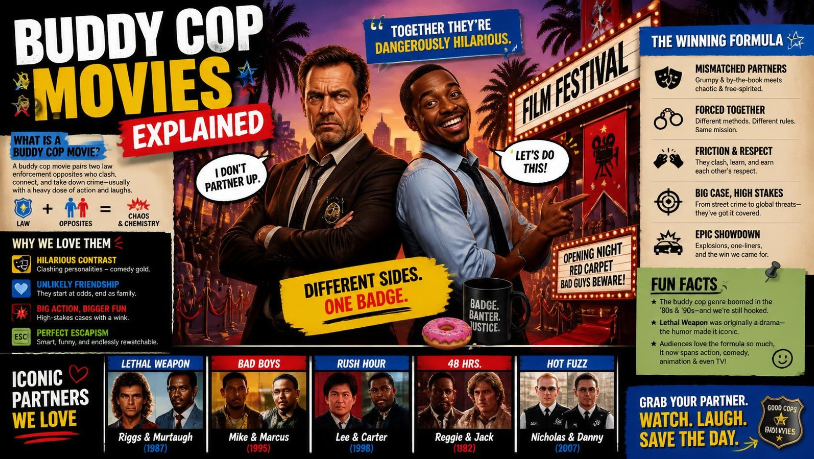
Quick answer: A buddy cop movie usually pairs two contrasting investigators who must solve a crime together. One may follow rules while the other ignores them. Their arguments create comedy and tension, while the case slowly turns their reluctant partnership into mutual respect or friendship.
Quick Facts About the Genre
| Topic | Key Detail |
|---|---|
| Basic formula | Two contrasting partners work together on a criminal case |
| Common genres | Action, comedy, crime, thriller |
| Main appeal | Chemistry, conflict, banter, action, and friendship |
| Important precursor | Stray Dog from 1949 |
| Major 1980s examples | 48 Hrs. and Lethal Weapon |
| Later examples | Rush Hour, Bad Boys, The Heat, Hot Fuzz |
| Common character contrast | Rule follower versus reckless partner |
| Typical ending | The partners develop trust after surviving the case |
Key Takeaways
- The partnership matters as much as the criminal investigation.
- Opposing personalities create conflict without requiring a complicated plot.
- The modern formula became especially recognizable during the 1980s.
- Movies can use the formula even when both characters are not police officers.
- Comedy often comes from personality differences rather than separate comic scenes.
- Modern versions can parody, reverse, or question familiar police-movie conventions.
What Makes a Buddy Cop Movie Different?

The central relationship separates these movies from ordinary police thrillers. A standard crime story may focus mainly on clues, suspects, and the final arrest. This genre makes the changing relationship between two partners part of the main story.
The partners usually disagree about rules, tactics, personality, or background. One character might be disciplined while the other acts on instinct. Their differences create natural arguments without requiring artificial conflict.
The case forces both characters to depend on each other despite those disagreements. Success becomes difficult unless they adjust their behavior. The crime therefore provides pressure that pushes the personal relationship forward.
Buddy Cop StudioBinder identifies contrasting personalities, forced partnership, and evolving friendship as major characteristics. Other genre references describe the same movement from friction toward trust.
The Formula That Keeps the Genre Moving
Most examples begin with a partnership neither character would voluntarily choose. The first meeting may involve irritation, distrust, or open hostility. That gives the story an immediate source of energy before the central case develops.
The two partners then encounter a problem that neither can solve alone. Different skills suddenly become useful rather than irritating. A reckless detective may act quickly, while a careful partner notices what everyone missed.
Their relationship usually changes after danger raises the stakes. Respect replaces annoyance once each character proves dependable. Friendship often becomes the emotional reward after the criminal problem is resolved.
This structure gives audiences two stories at once. They can follow an investigation while watching a relationship change. That combination helps explain the formula’s staying power across several decades.
Common Tropes You Will Recognize
Certain patterns appear so often that viewers recognize them within minutes. Filmmakers can play these ideas seriously or turn them into jokes. Familiarity becomes useful because audiences understand the relationship quickly.
Common elements include:
- A careful officer paired with a rule-breaking partner.
- An experienced detective matched with an inexperienced newcomer.
- Two characters from different cultural or professional backgrounds.
- A frustrated police captain dealing with both partners.
- Arguments during dangerous situations.
- A case that becomes personal for one investigator.
- A temporary breakup before the final confrontation.
- Mutual respect that develops near the ending.
These ideas are flexible rather than mandatory rules. 48 Hrs., for example, pairs a police officer with a convict. The relationship can still follow the same mismatched-partner structure.
How the Genre Developed
Film historians often point to Akira Kurosawa’s Stray Dog from 1949 as an important precursor. Its two investigators differ in age and experience while pursuing a dangerous criminal. Later movies turned that type of partnership into a more recognizable formula.
In the Heat of the Night offered another influential pairing in 1967. Sidney Poitier and Rod Steiger played investigators divided by race, background, and authority. Their uneasy cooperation carried social tension far beyond ordinary detective conflict.
The modern formula became much clearer during the 1980s. Walter Hill’s 48 Hrs. arrived in 1982 with Nick Nolte and Eddie Murphy. Its combination of crime, action, personality clashes, and humor became highly influential.
Lethal Weapon strengthened the model in 1987 through Martin Riggs and Roger Murtaugh. Their contrasting personalities became central to the movie’s emotional and comic appeal. The film also helped define expectations for later action partnerships.
Why Mismatched Partners Work So Well
Conflict arrives automatically when two opposite personalities share every important scene. Writers do not need constant villains to create tension. A simple conversation can become entertaining because each partner approaches the problem differently.
The contrast also gives both characters room to change. The cautious person may learn to take risks. The impulsive character may learn patience, loyalty, or responsibility.
Audiences can therefore enjoy predictable structure without knowing every emotional outcome. The basic pattern feels familiar, but chemistry changes from movie to movie. Casting becomes especially important because weak chemistry can expose the formula, which is why a Brenda Song career profile is a useful example of how performers build screen chemistry across comedy and drama.
Comedy also feels connected to the story rather than added afterward. Arguments can continue during fights, interrogations, or car chases. Humor comes from character reactions while the plot keeps moving.
Famous Examples and What Each One Adds
Several movies show how much variety can exist inside the same basic structure. Some emphasize gunfights, while others favor comedy or social differences. The strongest examples give their central pair a distinct relationship.
| Movie | Partnership Style | What Stands Out |
|---|---|---|
| 48 Hrs. | Cop and convict | Fast verbal conflict and reluctant cooperation |
| Lethal Weapon | Reckless cop and veteran detective | Action mixed with emotional character development |
| Rush Hour | Hong Kong inspector and LAPD detective | Cultural differences, comedy, and martial arts |
| Bad Boys | Two Miami detectives | Friendship, swagger, and large-scale action |
| The Heat | FBI agent and Boston detective | Personality conflict with two female leads |
| Hot Fuzz | Ambitious officer and friendly local cop | Genre parody mixed with a genuine partnership |
| The Nice Guys | Enforcer and private investigator | Detective mystery with dysfunctional comic chemistry |
The table also shows why strict definitions can become difficult. Not every famous example contains two conventional police officers. The broader formula depends more heavily on mismatched investigators, forced cooperation, and developing trust.
That flexibility lets filmmakers move the structure between comedy, thriller, science fiction, and animation. The relationship remains recognizable even when the setting changes. This makes the formula more adaptable than its name suggests.
How to Recognize One in Five Questions
You can usually identify the genre without checking an official category. Focus on how the central relationship drives the story. These five questions provide a simple test.
- Are two contrasting characters forced to investigate the same problem?
- Do their personalities or working methods repeatedly create conflict?
- Does their banter matter almost as much as the case?
- Do they become more dependent on each other as danger increases?
- Does their relationship improve or change before the story ends?
A movie matching most of these points probably uses the formula. Both characters do not always need badges. The partnership structure matters more than a literal job title.
This distinction helps explain why viewers sometimes disagree about certain films. One person may use a narrow police-only definition. Another may classify any mismatched crime-solving partnership under the same tradition.
How the Formula Changed Over Time
Later filmmakers began using audience familiarity as part of the joke. Once viewers knew the clichés, movies could exaggerate them deliberately. Parody became another way to keep the structure useful.
Hot Fuzz works partly because viewers already understand police-action conventions. It makes those conventions ridiculous while still building a sincere friendship. The movie can mock the formula without abandoning its emotional payoff.
Other films changed who could occupy the traditional roles. The Heat placed two women at the center of the partnership. Movies and television have also expanded the formula beyond its earlier male-dominated image.
The genre has faced more serious criticism as public conversations about policing changed. Academic research has examined how these movies connect humor, police violence, race, and authority. That perspective gives modern viewers another way to interpret older favorites.
Why the Genre Still Matters
The formula survives because it is fundamentally about relationships rather than police procedure. Two incompatible people must learn how the other thinks. Crime gives that personal adjustment urgency and consequence.
That structure can survive changing tastes because filmmakers can replace almost everything around it. They can change location, gender, tone, age, profession, or cultural background. The central conflict between reluctant partners still works.
For entertainment readers, it also offers an accessible way to understand screen chemistry. Magzina’s profile of Jared Padalecki’s early acting career shows how performers develop across different genres. Its coverage of Brenda Song provides another look at how actors move between comedy and drama.
Screen partnerships depend heavily on performers making written conflict feel believable. A memorable pairing can outlive the mystery or villain that brought them together. That is why audiences often remember the partners before remembering the case.
Why the Partnership Matters More Than the Badge
The genre works because the criminal case creates a reason for two incompatible people to stay together. Action can attract viewers, but chemistry keeps the partnership memorable. The best films make character growth feel connected to solving the case.
That also explains why the formula extends beyond traditional police stories. Audiences respond to friction, trust, loyalty, and friendship in many settings. The badge is useful, but the relationship is the real engine.
If you enjoy tracking how familiar performers and screen formulas evolve, explore Magzina’s wider entertainment coverage next. The site’s Kaitlan Collins profile and other personality features offer more background-focused reading. They provide another route into the people and media shaping American popular culture.
Frequently Asked Questions
What does buddy cop mean?
Buddy cop describes a movie or television formula built around two contrasting crime-solving partners. They usually begin with conflicting personalities, methods, or backgrounds. Their working relationship then changes as they face the same threat.
Do both characters have to be police officers?
No, many widely recognized examples stretch beyond two literal police officers. One character may be a convict, private investigator, agent, or civilian. The mismatched crime-solving partnership remains the defining feature.
What was the first movie in the genre?
There is no completely uncontested single answer. Stray Dog from 1949 is frequently described as an important early precursor. 48 Hrs. is widely associated with establishing the modern action-comedy formula.
Why were these movies especially popular during the 1980s?
The decade strongly favored American action cinema and memorable star pairings. Films such as 48 Hrs. and Lethal Weapon combined action with humor and character conflict. Their commercial visibility helped make the formula easy for audiences to recognize.
Is Rush Hour part of the genre?
Yes, Rush Hour is commonly classified within this tradition. Jackie Chan and Chris Tucker play investigators with different backgrounds and working styles. Their cultural misunderstandings and growing cooperation drive much of the comedy.
Are these movies always comedies?
No, although humor appears in many famous examples. Some entries lean more heavily toward action, thriller, drama, or social commentary. What matters most is the developing relationship between mismatched partners.