Mathematical formulas shape our daily routines, providing the framework that supports many decisions. From plotting a road trip route to calculating interest on savings, these equations are fundamental. Without them, everyday tasks would become insurmountable challenges.
In various professional fields, these mathematical tools are indispensable. Engineers rely on them to construct sturdy buildings and infrastructure, economists use them to predict economic trends, and even in creative fields like graphic design, formulas help in resizing images and achieving balance and proportion.
Compiling a math formula booklet involves more than just gathering equations; it requires a deep appreciation of their significance in our lives and their potential to solve practical problems. This guide aims to help you create a resource that is comprehensive, user-friendly, and easy to navigate.
Advantages of a Math Formula Booklet
Having a math formula booklet offers numerous advantages. For students, this compact guide is crucial during exam preparation. Instead of navigating through dense textbooks or endless online searches, they can quickly find the needed formula. This reduces study time, alleviates stress, and enhances academic performance. Educators benefit as well, as the booklet serves as a consistent resource for teaching and revising key mathematical principles.
Feedback from both students and educators highlights the tangible benefits of using a math formula booklet. A student mentioned that the resource boosted their confidence during tests. An educator noted that the booklet allowed them to focus more on developing problem-solving skills rather than on memorization.
The utility of math formula booklets extends beyond educational settings into various professional fields. Engineers, architects, and data analysts often rely on quick access to complex formulas in their daily tasks. An organized and accessible booklet minimizes information search time and reduces the likelihood of costly errors, proving itself as an invaluable asset in professional contexts.
Selecting Key Math Topics
Choosing the right math topics for your booklet is crucial. Start by aligning with curriculum standards that suit your specific needs. For students, this often means including subjects like algebra, geometry, and calculus that appear in their academic syllabi. Professionals might focus on industry-specific formulas essential for their daily tasks.
Understanding the challenges students face with certain mathematical concepts is vital. Incorporating a diverse array of formulas can help overcome these obstacles. Consulting educators or peers can also provide valuable insights into which topics are essential.
After identifying the key topics, organize them by their importance and frequency of use. This strategy will help you create a booklet that’s not just comprehensive but also immensely practical. Aim to produce a resource that serves as an easy reference point, prioritizing quality over quantity when selecting which formulas to include.
Organizing Your Content
The organization of your math formula booklet is essential, almost as important as the formulas themselves. To make your booklet user-friendly, consider organizing the content by themes. This method groups similar mathematical concepts together, making it easier for users to find related formulas and understand their interconnections.
Alternatively, you might choose to arrange the material in a sequence that mirrors how topics are typically introduced in educational settings. This format can be particularly beneficial for students who use the booklet while studying, as it reflects the natural progression of their academic syllabus. Regardless of the organizational style you select, maintaining consistency throughout is key.
Enhance navigability by incorporating color-coded sections or tabs within your booklet. These visual cues enable quick access to different topics or sections. Adding an index or a table of contents will further streamline the search process, allowing users to locate information swiftly and efficiently.

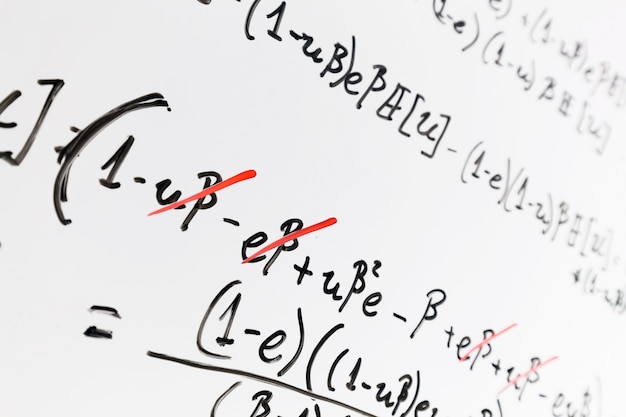
Image source: https://www.freepik.com/free-photo/close-up-still-life-hard-exams_23668657.htm
Crafting a User-Friendly Design
Creating a math formula booklet demands precision and an eye for design that caters to all users. Begin by selecting the right tools and software, such as Adobe InDesign or Microsoft Publisher, which are equipped with features designed to create a sleek and engaging booklet.
In your design process, consider every user, including those with disabilities. By integrating features like large print options and high-contrast color schemes, your booklet becomes more accessible. Moreover, choosing legible fonts and maintaining proper spacing can significantly enhance readability for a broader audience.
Strive for a balance between aesthetic appeal and functionality. A professional appearance is vital, yet the booklet’s usability reigns supreme. Avoid overcrowding pages with excessive details or intricate designs that might overwhelm users. Aim instead for a streamlined layout that guides users effortlessly to the information they seek.
Enhancing Comprehension with Visual Aids
Incorporating visual aids such as diagrams, charts, and graphs can revolutionize the way we understand mathematical concepts. These tools not only add clarity but also contextualize the information, thereby simplifying complex ideas. When crafting your booklet, strive for a harmonious blend of text and visuals to keep the content engaging.
Consider employing step-by-step illustrations to show practical applications of formulas. This method proves invaluable for visual learners by breaking down abstract concepts into tangible steps. Moreover, integrating real-world examples can bridge the gap between theoretical math and its practical uses, making the subject matter more tangible and comprehensible.
Choose your visual aids with care to ensure they directly enhance understanding rather than serving as mere decoration. Opt for purposeful visuals that actively aid in demystifying complex topics.
Ensuring Accuracy and Relevance
Keeping your math formula booklet accurate is essential. It’s important to routinely check and refresh its contents to keep it both correct and applicable. Establish a routine, perhaps with a checklist or timeline, for these revisions, and consider involving students or colleagues in the review process.
Soliciting input from those who use your booklet can significantly boost its quality. Motivate students and educators alike to voice their insights and proposals. This cooperative method does more than just polish the content; it builds a community of involved contributors who feel invested in the resource.
Given that mathematics is an ever-evolving discipline, punctuated by frequent breakthroughs and new techniques, staying abreast of these changes is vital. Be agile in updating your booklet with the latest mathematical developments to maintain its usefulness and dependability. By focusing on precision and current relevance, you ensure that your math formula booklet continues to be an indispensable educational tool.
Digital and Physical Formats
When deciding between digital and physical formats for your math formula booklet, it depends on what suits your needs best. Digital versions shine with their ease of access and portability, allowing you to swipe through formulas on a variety of devices wherever you may be.
Conversely, physical booklets offer a solid, tactile experience that many find reassuring. Without the need for electronic gadgets or connectivity, these are perfect for environments where tech might not reach.
Why not consider a blend of both? A hybrid model merges the convenience of digital with the reliability of physical formats. This way, you can tailor your choice to fit the occasion—opting for digital when efficiency is key, or going analog when deeper engagement is desired.
Enhancing Study Routines with a Math Formula Booklet
Integrating a math formula booklet into your study habits can considerably boost your learning journey. Employing strategies like spaced repetition and active recall not only deepens your grasp of the material but also enhances retention of crucial mathematical principles. A consistent review of the booklet ensures that these key concepts are not just understood, but remembered.
Active recall means challenging yourself to remember the formulas and how they apply in various scenarios. This approach promotes a more profound interaction with the content, pinpointing any areas that might require additional attention. Utilizing the booklet during these self-tests offers instant feedback, aiding in refining your understanding as you progress.
Spaced repetition entails revisiting the mathematical formulas at gradually increasing intervals. This method is designed to cement your knowledge and ward off forgetfulness. By weaving the math formula booklet into your daily study routine, you establish a systematic and effective method for conquering mathematical challenges.
Embark on Your Math Formula Adventure
Crafting a math formula booklet is not just an academic task; it’s a journey that promises to enrich the lives of students, educators, and professionals. By carefully selecting crucial topics, structuring the content with precision, and designing an accessible layout, you create more than just a tool—you forge a gateway to enhanced understanding and streamlined learning processes.
Opt for a digital, physical, or blended format—whichever suits your learning style best. Employ strategies like spaced repetition and active recall to unlock the full potential of your math formula booklet as an indispensable educational ally.
The moment to act is now: begin crafting your personalized math formula booklet. Encourage peers or educators to explore this article and consider creating their own booklets. Through collaboration and shared insights, we deepen our collective grasp of mathematics’ essential formulas—tools that shape our understanding of the world around us.
Apart from that if you want to know about “Should MBBS students be taught management?” then please visit our “Education” Category.