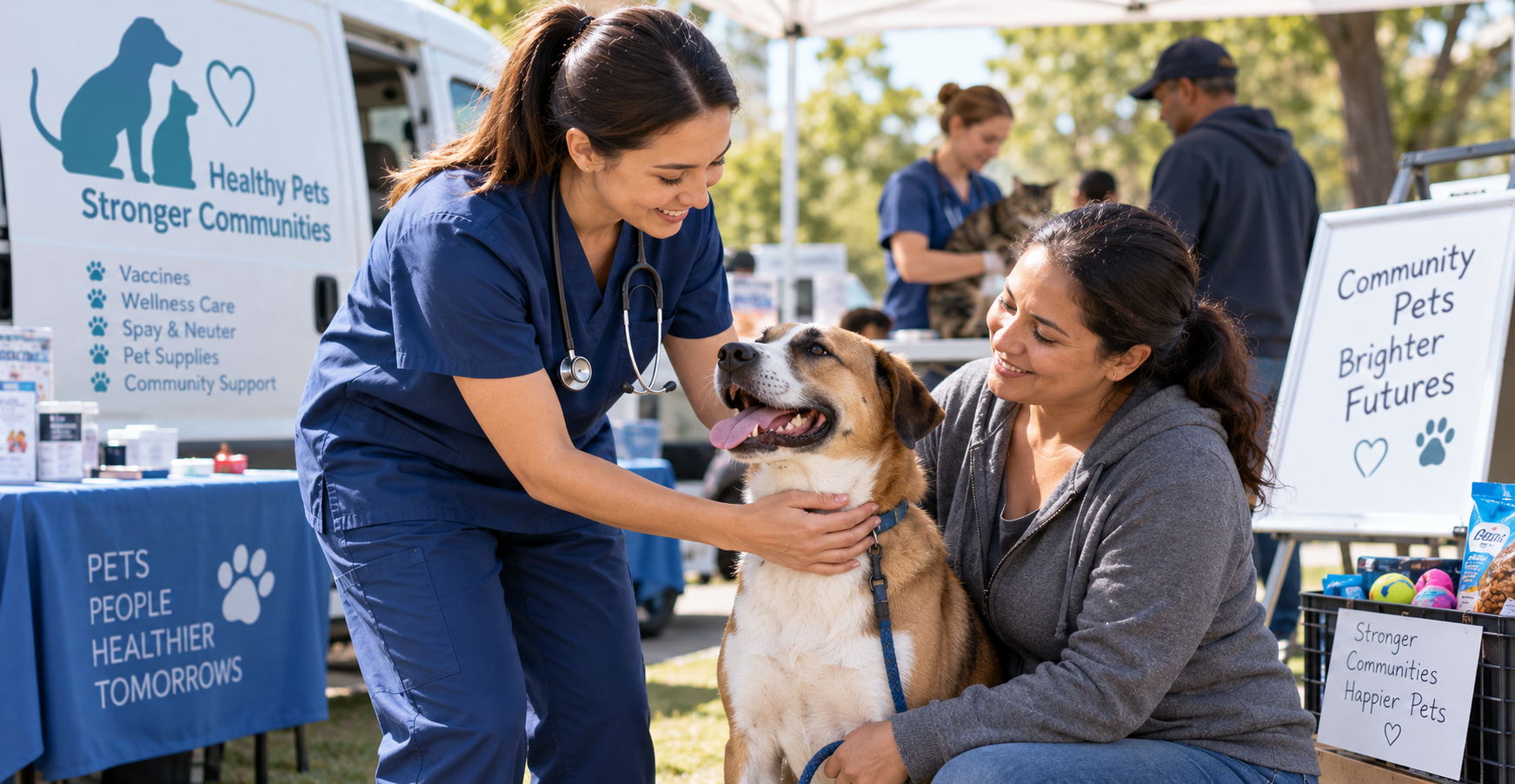
Saturday morning, a church parking lot, two folding tables and a cooler of vaccine vials. The line starts before the sign is taped to the fence. Some dogs arrive on rope leads; one woman carries a cat in a laundry basket.
That is veterinary community outreach. Not a marketing stunt, not a food drive with a stethoscope attached, but a delivery model built for animals a normal appointment book never reaches. When people ask what an animal hospital in South Houston, TX gives its neighborhood beyond treating whoever walks in, this is the honest answer: on some blocks, the clinic is the only animal-health infrastructure there is. What follows is how each format works, how it gets funded, the licensing traps, and where programs break. Owners looking for help can skip ahead to finding programs nearby.
The gap outreach is built to close
A conventional practice assumes a client who can find the building, book during business hours, and pay at checkout. Each assumption removes people. A standard clinic can do everything right and still never see the animal two streets over.
Transport is the filter clinics underestimate most: no car, or a car and no carrier, or a shift that ends at six when the doors close at five thirty. Cost is the second, though not the way clinics assume. It is not the price that stops people, it is not knowing the price, which is what a fixed published menu fixes. The third filter is social, and staff hear it constantly as an apology offered before anyone has touched the animal. Language is the fourth, and a bilingual volunteer fixes it.
The outreach formats clinics actually run
Outreach is not one thing. It is roughly seven, each with its own cost curve, partner list and failure mode, and most clinics never run more than three well at once.
Low-cost vaccine and microchip clinics
The entry point for almost every program. A clinic sets up in a hall for four to six hours with a short fixed list: rabies, core vaccines, a microchip, often a dewormer. Two boring details decide whether the day works: cold chain, meaning a monitored cooler rather than an ice chest and optimism, and records, because an untraceable rabies certificate is nearly useless and an unregistered microchip is a grain of rice in a shoulder. Register chips on a tablet while the owner is standing there.
Spay/neuter vouchers and TNR for community cats
The most expensive format per animal and the one whose effect lasts longest. Few practices carry surgical outreach alone, so it runs as a split: the clinic gives surgeon time or discounted theater slots, a rescue or municipal fund covers consumables, a shelter handles intake and recovery. Capacity is planned in animals per day, because the bottleneck is anesthesia monitoring and recovery space, never demand. Voucher schemes spread that load across several clinics, and their weak point is redemption, since the owner still has to arrange transport, fast the animal overnight and lose a day’s pay.
Trap-neuter-return is its own discipline. Community cats arrive in humane traps, are sterilized, vaccinated against rabies, ear-tipped for identification and returned to a colony with a caretaker. Induction and recovery happen in the trap, so the clinic needs a written protocol covering handling, pain control, ear-tip technique and what happens when a cat proves pregnant or too sick to return. The trapping itself is skilled volunteer work, usually done by a caretaker group.
Pet food pantries and supply banks
Cheap to run and consistently underrated. Surrender interviews surface food cost repeatedly, not because kibble is unaffordable alone but because it lands in the same month as the car repair. A shelf of donated food in reception prevents a category of surrender no clinical skill can touch. Skip means-testing, check expiry dates, refuse open bags, and the pantry runs itself.
Mobile units, pop-ups and transport help
A fitted mobile unit is a capital commitment whose costs run whether the calendar is full or empty: fuel, maintenance, insurance, a licensed driver, servicing that takes it off the road for days. A pop-up does much of the same work for far less, with tables, a canopy, coolers and a hall with a sink, and it can appear in a different housing complex every month. Cheaper still is moving the patient rather than the clinic, through loaner carriers, a volunteer driver roster, or veterinary stops added to a senior agency’s transport van.
Senior and veteran pet assistance
Older owners on fixed incomes and veterans with service or companion animals are two groups where a small targeted program pays off, because the animals are usually well cared for and simply overdue. Formats include a discounted senior wellness day, an arrangement with a Meals on Wheels chapter whose drivers already visit these homes and can flag a struggling pet, and a hardship fund earmarked by age. Several national nonprofits also fund veterans’ service animals, which is money a clinic never has to raise itself. For seniors who have moved into residential care, mobile veterinarians who visit assisted care settings fill a similar gap.
Comparing the models at a glance
The column that settles most planning arguments is the third, since the constraint is rarely money.
| Outreach model | What the clinic supplies | Main constraint | What it changes locally |
| Vaccine and microchip day | Vet, two techs, vaccines, chips, volunteers | Cold chain and record-keeping | Higher rabies coverage, fewer unclaimed strays |
| Spay/neuter voucher program | Discounted surgical slots, flexible scheduling | Voucher redemption and transport | Fewer unplanned litters across seasons |
| TNR day for community cats | Surgeon time, trap-side anesthesia workflow | Recovery space and trained trappers | Stabilized colonies, lower kitten intake |
| Pet food and supply pantry | Shelf space, storage, no means-testing | Donation flow and expiry dates | Fewer hardship surrenders |
| Mobile unit | Vehicle, crew, full equipment load | Capital and running costs | Care in dispersed or rural areas |
| Pop-up clinic | Tables, canopy, coolers, portable gear | No imaging, surgery or privacy | Rotating access across neighborhoods |
| Transport assistance | Carrier loans, volunteer drivers, held slots | Driver insurance and scheduling | Access for car-free and elderly owners |
| Supervised student clinic | Case supervision, teaching time, records | Faculty availability and case mix | Cheaper care plus a workforce pipeline |
Shelters, humane societies and animal control
Hardly any program runs on a clinic alone, and the partners tend to be the same three organizations.
Shelter medicine partnerships
Shelter medicine is a recognized specialty, not private practice performed on a crowd. The unit of care is the population: intake protocols, vaccination on arrival rather than at adoption, isolation and flow design, outbreak management. A clinic plugs in one of three ways. It takes cases beyond the shelter’s capability at an agreed rate. It acts as veterinarian of record where a shelter has none, which means protocol oversight and drug ordering, not a title. Or it treats foster animals at a set price, so a coordinator can say yes to a litter. Put it in writing.
Municipal animal control
Animal control is a government function with statutory duties: rabies control, bite quarantine, cruelty investigation, stray impoundment. Officers hold legal authority a clinic does not, so learn the local ordinance on quarantine and rabies certificates. The payoff is targeting. Animal control knows the street with the unaltered dogs and the block that produces kittens every spring, and an event held in that place moves impound numbers in a way general campaigns never do. City budgets also fund rabies compliance and stray reduction, which makes animal control a funding partner too.
Humane societies and rescues
Humane societies are private nonprofits rather than government agencies, and many have no enforcement role at all. What they bring is a donor base, volunteers, public trust, and 501(c)(3) status that lets grant money reach a program a for-profit clinic could not receive directly. Foundation funding is usually easiest as a joint application with a partner who already holds that status.
Education: schools, 4-H and student rotations
Education is the cheapest outreach available and the slowest to pay off. Forty minutes in a third-grade classroom with a stethoscope and a stuffed dog teaches bite-safety habits that prevent injuries. In agricultural areas, 4-H and FFA members need real husbandry guidance: nutrition, parasite control, vaccination schedules, and the biosecurity rules that keep an exhibition from becoming a disease event.
Where a veterinary college or technician program sits nearby, supervised student clinics deliver access and workforce development at once, and those institutions have already solved the supervision and liability questions. The UF outreach programs show how service delivery, teaching and community partnership can be structured as one system instead of three competing efforts. In both cases outreach sits inside the curriculum rather than bolted onto the teaching hospital, which is what lets it survive a change of staff. Private clinics can host students too, though what an unlicensed student may legally do varies by state.
Disaster response and evacuation support
Hurricane Katrina changed emergency planning for animals in the United States. People refused to evacuate without their pets, and the federal response included the PETS Act of 2006, which requires state and local emergency plans to account for household pets and service animals to qualify for federal preparedness funding. It is why co-located pet sheltering appears in most county plans.
Clinics contribute in predictable ways: staffing a pet shelter beside a human evacuation shelter, holding boarding capacity for evacuees, distributing donated food and crates, and absorbing the surge of displaced animals in the week after the water drops. The highest-leverage work happens earlier, at pre-season microchip events, because reunification depends almost entirely on identification.
Most states run a State Animal Response Team or county equivalent, and many have a Veterinary Medical Reserve Corps unit. Credentialing through one before an event decides whether you get deployed or turned away at a cordon, since incident command will not take a volunteer with good intentions and no paperwork. The other half is internal: a clinic with a written continuity plan, a generator, elevated drug storage and cloud-backed records is still a clinic after the storm.
Paying for it: grants, sponsorship and real costs
Everyone expects the supplies line. The one that bites is staff time, because outreach happens on a Saturday, and Saturday hours are either paid at a premium or borrowed from people who are already tired. Programs built on unpaid enthusiasm run well for about eighteen months, then collapse when the two organizers move practices. Funding comes from a mix:
- A client-funded hardship account. Round-up at checkout, a donation line on the invoice, or a memorial fund. Small, steady, entirely under the clinic’s control.
- Manufacturer donation programs. Vaccine and parasiticide companies run discount schemes for documented community events. Ask the territory representative, not a website.
- Municipal animal services grants. Money tied to outcomes the city wants: rabies compliance, sterilization counts, stray intake reduction.
- Private foundation grants. National welfare foundations fund access-to-care work, and most require a 501(c)(3) applicant, which is where a nonprofit partner earns its place.
- Local business sponsorship. A named event with a date sells far more easily than a program.
Grant applications want numbers, so collect them from the first event: animals seen, first-time contacts, ZIP codes, chips registered rather than implanted, surgeries completed against referrals. A return shows up in the practice’s own books too, on a one- to two-year lag, as vaccine-day animals come back for dentals and chronic care.
Licensing, liability and records
This is what ends programs before they start, and it is manageable when handled early. Rules vary by state, so the first call goes to the state veterinary medical board.
The veterinarian-client-patient relationship. Treating and prescribing require a valid VCPR, and how one is established off-site is set by state law. Vaccinating at an event generally creates one for that encounter, which does not extend to refilling a chronic medication for an animal seen once in a parking lot.
Permits and rabies certificates. Many states license the facility as well as the practitioner, and a mobile unit or temporary site may need its own registration. Rabies sits under separate rules: who may administer it, what the certificate must contain, who signs, and how the record reaches the county are all set locally.
Controlled substances. Anesthesia and scheduled analgesics bring DEA registration, storage and transport rules into play, and taking controlled drugs off-site is stricter than most teams assume. That is the main reason surgical outreach belongs inside a licensed facility rather than a tent.
Insurance, volunteers and records. Professional liability does not automatically follow you off-site, and public event coverage is separate again. Volunteer drivers need a conversation about their own auto policy, and non-veterinary volunteers should stay within tasks that need no license. Every animal needs written consent, owner contact details, and a record of what was given with product, serial and site.
What clinics gain, and where programs break
The benefit owners mention most and expect least is staff retention. Compassion fatigue is driven partly by the feeling of being unable to help, and outreach points the other way. The rest stacks up over time: a broader client base, standing referral relationships, easier recruiting, and a local reputation no advertising budget buys. The barriers are just as consistent.
Staffing beats every other constraint. The profession is short on veterinarians and shorter on credentialed technicians. Asking a stretched team for weekends produces resentment that surfaces later as turnover, so pay the hours or give the time back.
The follow-up gap is the hard one. An event finds a mammary mass, a mouth of rotten teeth, a heartworm-positive dog, and without a funded pathway you have diagnosed a problem you cannot fix. Write the escalation policy before the first event: what gets treated on site, what gets referred in at a hardship rate, what goes to a partner fund, and what the team says when nothing can be offered.
Solving the wrong barrier wastes the effort. Clinics assume cost is the obstacle because cost is what they control. Ask the food bank, the shelter and the school what they see. Where the real constraint is transport, hours or language, a discount changes nothing. Launching too big does the same, since one huge event sets an expectation nobody can repeat.
Headcount measures the flyers, not the access. The informative numbers are follow-through: return visits within twelve months, chips registered, surgeries completed against referrals, and shelter intake for the target area over two years. The last two need partner data, so agree on measurement with the shelter before the first event. And write the procedures down, because a program held together by one enthusiastic person ends when that person leaves.
How pet owners can find programs nearby
These services are poorly advertised, so work through the organizations that coordinate them:
- Your municipal animal shelter or animal services office. They usually keep the county list of every low-cost clinic, voucher program and vaccine event.
- The local humane society or SPCA. Many run their own clinic or administer sterilization vouchers.
- 211. Pet assistance is increasingly listed alongside human services.
- The nearest veterinary college. Teaching hospitals often run community clinics at reduced fees.
- Your food bank or senior services agency. Pet pantries frequently ride along with human food distribution.
- Your own veterinarian. Plenty of practices hold hardship slots, payment plans or a memorial fund that never appears on the website. Reception hears the question every week.
A few practical things help on the day. Arrive early, since most events work first-come and cap the list. Bring any previous rabies certificate, since it changes which vaccine your pet needs, and bring cash unless card payment is confirmed. Dogs on a secure leash, cats in a carrier. Ask what is included before you join the line, and ask what happens if the vet finds something that needs treatment.
Frequently Asked Questions
What is a veterinary community outreach program?
It is any organized effort by a clinic to deliver care outside its normal appointment model, aimed at pets whose owners face cost, transport, schedule or language barriers. Common formats include low-cost vaccine and microchip days, subsidized spay and neuter access, pet food pantries, mobile or pop-up clinics, and medical support for shelters and rescues. Almost all of it runs with partners rather than alone.
Do I have to prove low income to use a low-cost vaccine clinic?
Usually not. Most vaccine and microchip events are open to whoever turns up, because screening paperwork slows the line and discourages the people the event exists to reach. Subsidized surgery and voucher programs often do ask for proof of address, income or a public benefit, since the funding behind them is restricted. Food pantries vary. Call ahead and ask what to bring.
Are vaccines given at a pop-up clinic the same as at a regular practice?
The products are the same ones the clinic stocks, kept in a monitored cooler and given by or under the supervision of a licensed veterinarian. What differs is scope, not quality: a pop-up offers a short fixed list rather than a full workup, with no imaging or laboratory on site. You should still leave with a written record and a rabies certificate.
Can a community clinic treat my pet if it is already sick?
Often not on the day, and that limit is deliberate. Events publish a short menu of preventive services so pricing stays predictable and the line keeps moving. A veterinarian who spots a real problem will examine your pet, explain what they found, and point you to the referral route, which may be a discounted appointment or a partner hardship fund. Ask on arrival.
What is TNR, and why do veterinarians support it?
Trap-neuter-return is the standard approach to unowned community cats. Cats are humanely trapped, sterilized, vaccinated against rabies, ear-tipped so they can be identified at a glance, and returned to a colony where a caretaker feeds them. Veterinarians support it because sterilizing a colony stabilizes it, reduces the kitten intake that overwhelms shelters each spring, and raises rabies coverage in a population that otherwise gets none.
How can a small practice start outreach without losing money?
Start smaller than feels impressive. One reserved hardship appointment a week, a donated food shelf in reception, or an agreement to take referrals from one local rescue all count as a program. Cost the staff hours honestly from the start, seed a hardship fund with a round-up option at checkout, and ask your vaccine representative about donation schemes before buying anything. Then repeat it quarterly.
Where to go from here
What people remember is not the vaccine. It is that someone made room for an animal they could not afford to lose, without making them feel small.
If you own a pet: call the county animal shelter this week and ask what low-cost services exist nearby, then check that your pet’s microchip is registered to a number you still use. If money is the barrier, say so at your own clinic.
If you run a clinic: ask the shelter, food bank or school which barrier they actually see. Pick one service small enough to repeat quarterly. Call the state board about licensing and your insurer about off-site cover before setting a date. Write down how the day runs, and agree with a partner on what success looks like.